
For the last several years, I have written a blog post with the title “wishing you…” It start back at the new year when 2017 rolled to 2018, and it was brought about, in large part, as a way to deal with the ongoing grief of my daddy’s death. I wrote a lot then as a way to get myself through each minute, each day. And in that writing, I found a way to carry the grief. Back then, I was often reminded of my good friend, Esther Richey, who is likely the person most responsible for my present occupation as a college professor.*
Back when I started grad school, Es was dealing with her own grief** and she started her own version of a Renaissance coterie.*** We would gather at her house where she cooked for us, and we would discuss whatever our common reading was. We did the Bible for a while, but not the Bible itself, rather, mostly scholarly interpretations of it. I stayed late one week. Es and I share a deep spirituality so her choices I found curious. I wondered why she started us out with the readings she did instead of the Bible itself. When I posed this question to her, she smiled in that way she always did and took my hand in hers and said, “The most important part of any story is how we react to it. You have to find the grace in it.”
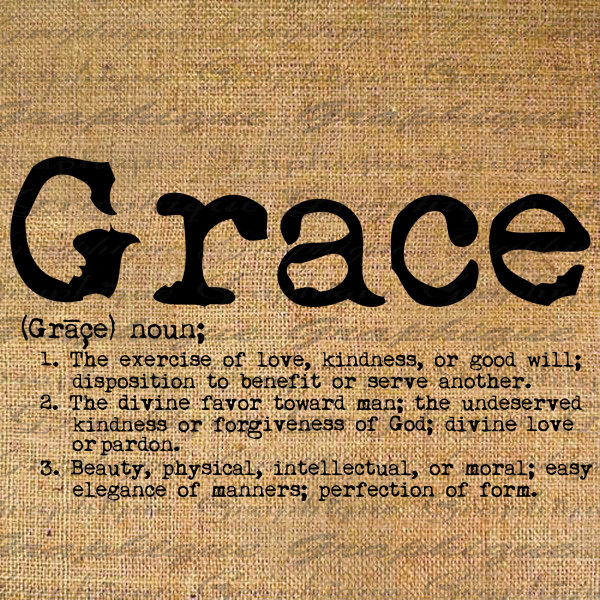 Grace.
Es and I returned to this word my entire time in grad school. It was the perfect word to deconstruct and work through because it has so many meanings. For Es and I, we often started with grace and its role in religion and spirituality. The Grace of God and what that means. For most in Christian religions, the grace of God is where we draw strength and rejuvenation and forgiveness. It was a word we returned to often in our conversations.
Over the past couple of years, I am almost haunted by those conversations as I have replayed them alongside so many events in life—joyful and sad and trying and laughing. Those conversations helped to remind me to consider grace in all its forms and most importantly, to work at enacting grace more and better in my own life.
I owe Es a great debt. Here, debt is not necessarily a process of repayment or recognition, but rather debt is a gift to that passes from one to another as a collective process of extending grace. Debt is in motion; it “runs in every direction, scatters, escapes, seeks refuge.”^ I like this image of movement because debt as gift, debt as grace has to run, to be given, to be extended. Grace is, should be, in perpetual motion as it moves from person to person, embodied, encompassing.
Cajun culture is rife with references to movement, to doing, to acting, to making. The French language itself reminds of the importance of movement and emerging through the verb “to be”, être. One cannot speak or understand French without knowing the vast usage of to be, being, becoming, emerging. And so many of the phrases and idioms that drive Cajun French state, begin, end, use some form of to be.
Being. To be then means action and making so it should be no surprise then that for me grace has to move. I can see my grandmothers’ surprised face as I embrace this idea and present it to you. In some ways, grace is a gift we don’t deserve. Or it often feels that way when we consider it for ourselves or we get in our way when we are slow to extend it to others. But in many contemplative moments over the last year, those conversations with Es collided with ones from my grandmother and my father and so many other voices and moments and actions….grace in its most powerful has to start with ourselves first and then move outward, as a debt, as gift to others.
So to each of you in 2022, I wish you grace.

*It really is a great story. Next time I see you and you’re curious, I’ll tell you all about it. The story has fire and everything.
**Esther’s beautiful soul of a husband, Bill, died early in the Fall term of 2002. She and the little Miss were devastated. I like to think that having us all there so often helped them both ins ome small measure find their way through.
***While the group us had/have different academic specializations, we all had an appreciation for the literature and culture of the early modern period (aka the Renaissance). That is likely the only common thread we had because to this day I am still a bit surprised at the eclectic nature of that group and that we gathered so consistently.
^This idea of debt as gift comes from Stefano Harney and Fred Moton (2013) in the Undercommons. See chapter 4; the quote is from p.61.